Wind Farm O&M: The Data Behind Reliable Wind Turbine Operations
Wind turbines are complex assets that require inspection, maintenance, monitoring, documentation, and informed decision-making throughout their operating lives. Modern wind farm O&M depends not only on maintaining the equipment, but also on collecting, connecting, and using the information generated in the field.
 Field crews generate inspection, measurement and maintenance information across the operating life of every turbine.
The Scale of the Wind Industry
Operational data matters because of the sheer size of the fleet that now has to be run, inspected and maintained every year.
According to the GWEC Global Wind Report 2026, global installed wind power reached 1,299 GW in 2025, and the industry installed 165 GW of new capacity worldwide that year. Within that 2025 installation year, GWEC reports 28,395 wind turbines installed across 57 countries, and wind power is now present in 138 countries.
As the installed base grows, the operational challenge shifts from deploying turbines to maintaining, monitoring, documenting, and managing increasingly large fleets of operating assets — a challenge measured in inspection rounds, work orders, component histories and maintenance records, not just megawatts.
28,395
wind turbines installed across 57 countries, reported for the 2025 installation year138
countries worldwide now have wind power, GWEC reports165 GW
of new wind capacity added worldwide in 2025Global wind capacity, 2025
GW (gigawatts) — figures as reported in the GWEC Global Wind Report 2026What Is Wind Farm O&M?
Operations and maintenance (O&M) covers the day-to-day running of a wind farm and the upkeep of its turbines. In practice, the two sides are inseparable: every maintenance visit is also a chance to observe the asset, and every operating day produces information that maintenance planning depends on.
Operations
— Monitoring turbine operation
— Reviewing operating conditions
— Tracking performance
— Responding to alarms or abnormalities
— Coordinating field activities
— Managing site activities
Maintenance
— Scheduled inspections
— Preventive maintenance
— Corrective maintenance
— Component inspection and troubleshooting
— Repair and replacement of worn or failed components
— Documentation of completed work
The U.S. Department of Energy Career Map for Wind Technicians describes the field side of this work. Wind technicians may be responsible for inspecting tower exteriors and physical integrity, climbing towers to inspect, troubleshoot, and repair equipment, collecting turbine data, performing routine maintenance, testing electrical, mechanical, and hydraulic systems, and replacing worn or malfunctioning components. Not every technician performs every one of these activities on every project — the mix depends on the site, the fleet, and the service arrangement.
Where O&M is delivered by a third party, those responsibilities — maintenance scheduling, reporting and record-keeping among them — are typically set out in the O&M agreement. The DOE's guidance on O&M agreement considerations for on-site wind energy projects is a U.S. federal resource, not an international standard, but it illustrates how much of an O&M program is defined contractually as information obligations.
Why O&M Matters Economically
O&M is not simply a maintenance-department expense. It is an ongoing operational function that affects the cost, availability, reliability, safety and long-term management of wind assets.
NREL's 2024b Annual Technology Baseline defines OPEX as the all-in fixed and variable expenditures required to operate and maintain a wind plant. For its reference data, the ATB reports a 2022 market-average turbine rating of 3.2 MW and OPEX of $44/kW-year for that 2022 market-average turbine.
That $44/kW-year is the ATB's reference value for a specific market-average turbine — not a universal current O&M cost. NREL shows that O&M costs vary with turbine rating and technology.
NREL's work on wind turbine maintenance costs reports that O&M makes up approximately 17%–34% of the lifetime cost of wind energy, and identifies gearbox maintenance as a significant cost driver.
Where O&M sits in lifetime cost
O&M Is More Than Repairing Turbines
Modern wind farm O&M runs on several interconnected streams of information. These are examples of information that may exist across an O&M program — not every wind farm collects all of it in the same system.
Asset information
Inspection information
Maintenance information
Monitoring information
Documentation
A gearbox replacement, a blade inspection with photos, a SCADA alarm history and a commissioning record may all describe the same turbine — but they only become useful together when they can be associated with the same asset, over time.
The Field Technician Is Part of the Data System
Physical work and information are two halves of the same activity. Every inspection, measurement and photograph a technician captures on site becomes input for testing, analysis, troubleshooting, maintenance planning and documentation.
From tower climb to historical record
The DOE wind technician career map includes collecting turbine data alongside inspection, troubleshooting and repair activities. For an O&M organization, that means the technician climbing the tower is not only performing maintenance — they are also one of the most important sensors in the system. What they observe, measure and photograph is the raw material for every later engineering decision about that asset.
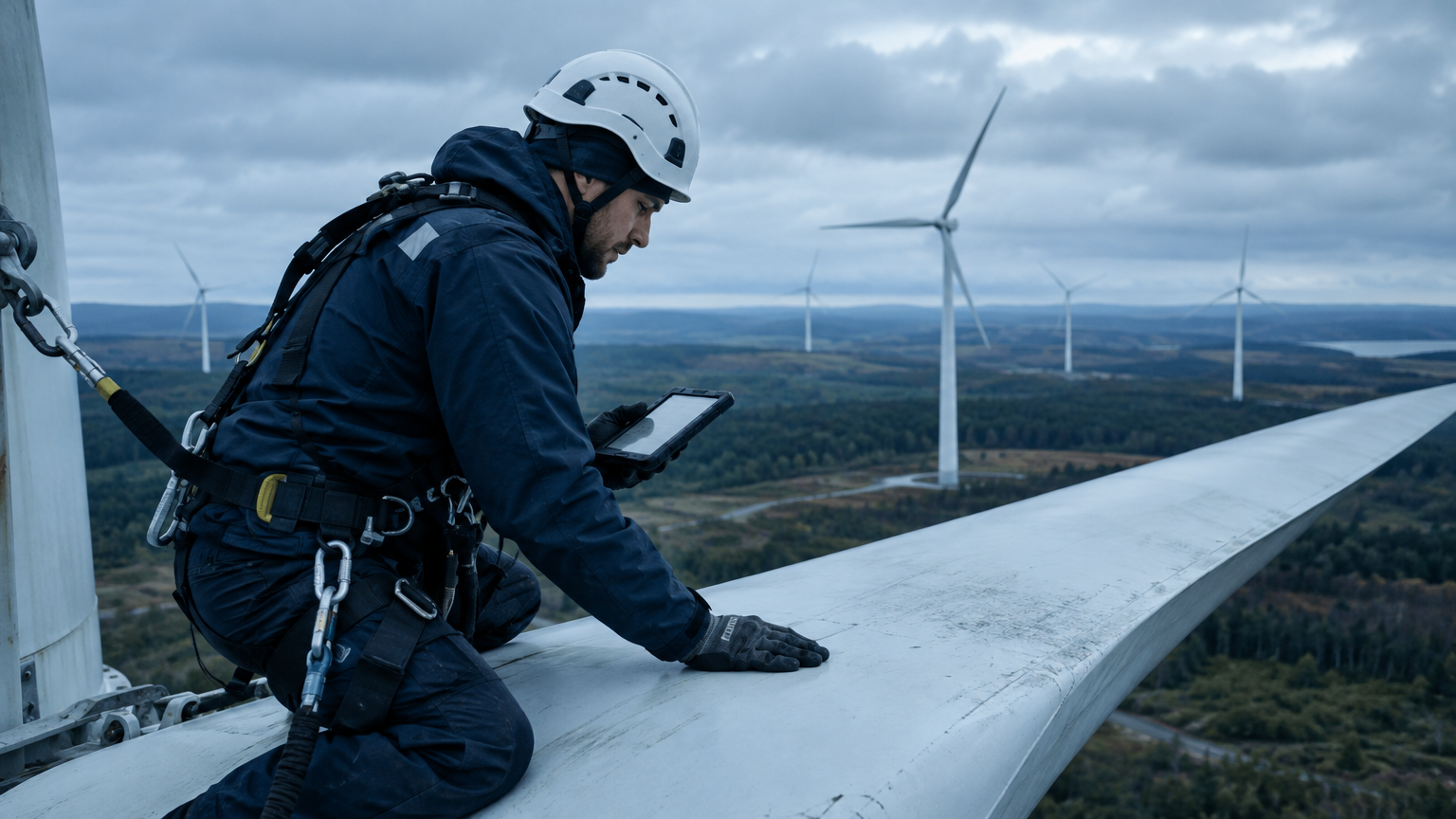 Inspection work at the turbine: observations, measurements and photographs collected on site become the turbine's record.
What Needs to Be Inspected?
A utility-scale wind turbine is a stack of interacting systems, each with its own failure modes, inspection methods and maintenance requirements.
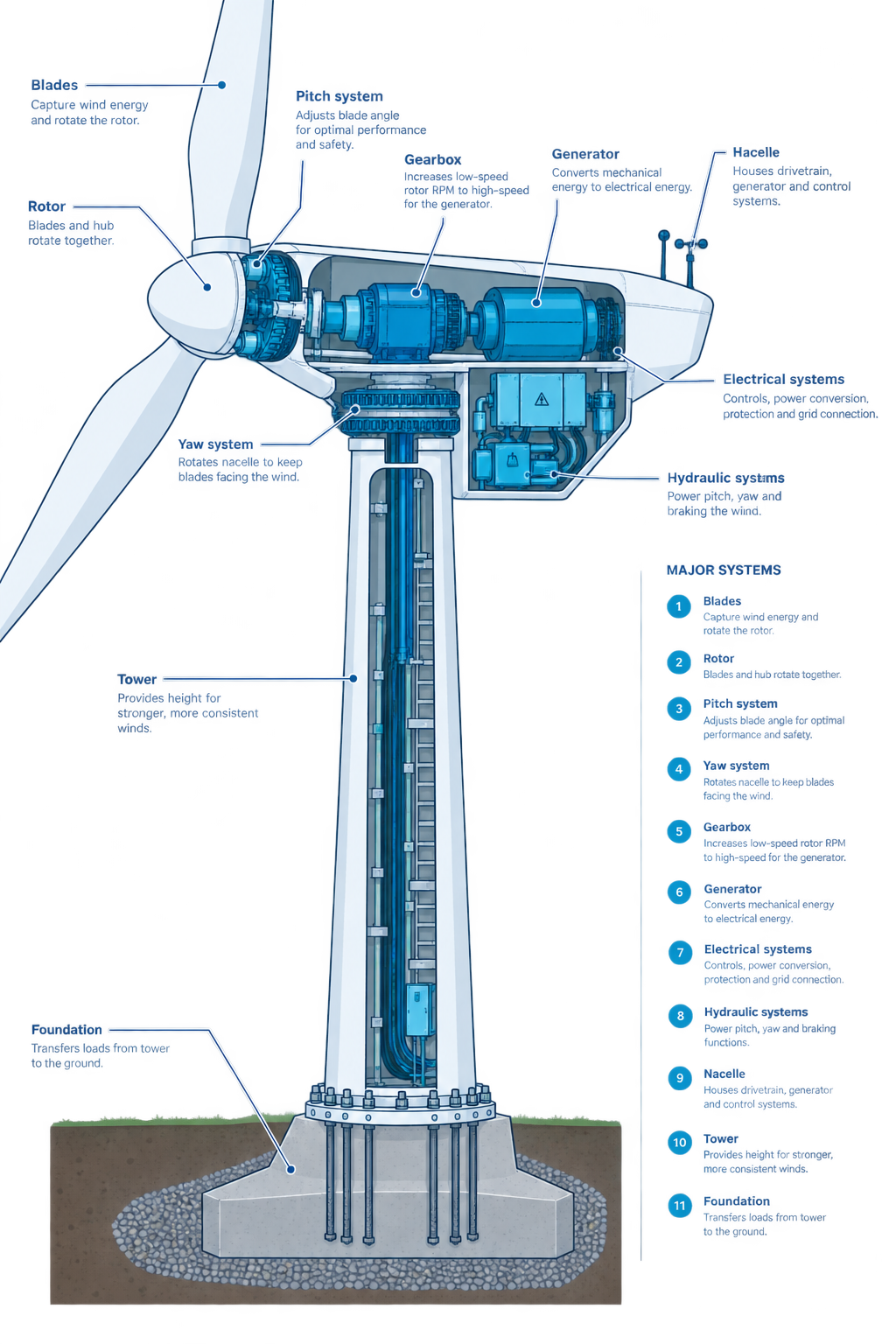 Major systems of a wind turbine — illustrative; actual inspection scope is set by the OEM, the O&M program and applicable standards.
Examples of systems and components that O&M programs inspect and maintain include the tower, foundation, blades, rotor, pitch system, yaw system, nacelle, drivetrain, gearbox, generator, and the electrical, hydraulic, control and auxiliary systems. The list is illustrative rather than exhaustive — the required inspection and maintenance scope for any given turbine depends on the manufacturer's documentation, the site's O&M program and applicable standards.
On the safety side, IEC TS 61400-30:2023, Safety of Wind Turbine Generators addresses essential health and safety requirements and covers safe operation, inspection, maintenance, installation and decommissioning. It is a technical specification — a standard to work to, not a maintenance checklist to copy, and the safety requirements it defines apply to how the work is done as well as what is done.
Inspection Data vs. Condition-Monitoring Data
Wind O&M draws on two complementary kinds of information: what people observe in the field, and what the machine reports about itself. Understanding the difference is essential.
Field inspection data
Captured by people, on site, at a point in time:
— Visual observations
— Photographs
— Measurements
— Component condition
— Defects
— Maintenance findings
— Technician notes
— Inspection checklists
Condition-monitoring data
Generated by the turbine and its sensors, continuously or periodically:
— SCADA data
— Sensor data
— Vibration measurements
— Operating parameters
— Continuous or periodic monitoring information
A peer-reviewed review of recent advances in wind turbine condition monitoring using SCADA data explains that SCADA systems can provide operational data for condition monitoring, and discusses both model-based and data-driven monitoring approaches for fault detection and diagnosis. Field inspection records and machine-generated monitoring data are complementary information sources: monitoring can flag a change in behaviour, while an inspection explains what is actually happening on the component — and the inspection finding is only useful later if it was recorded well enough to compare against.
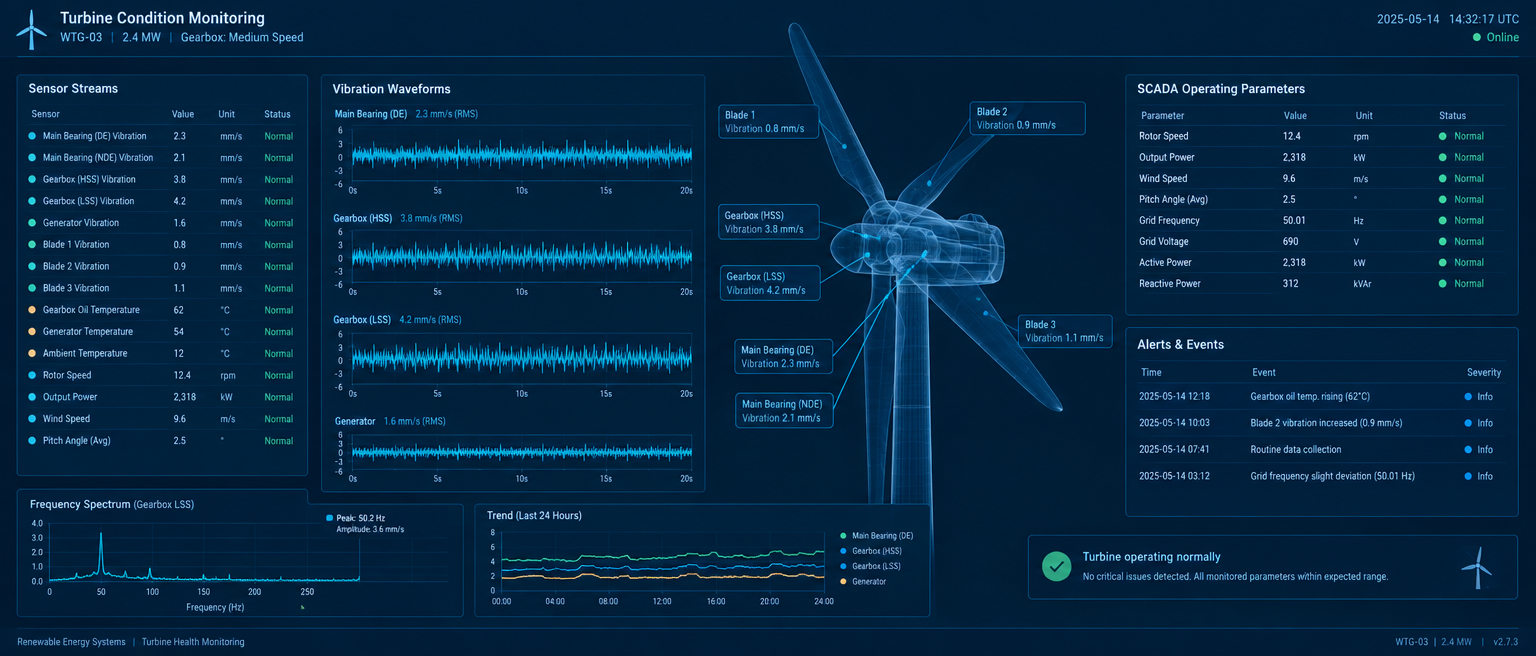 SCADA and condition-monitoring data describe how the turbine is running; inspection records describe what technicians found.
Why Historical Data Matters
A single inspection is a snapshot. The value of O&M records compounds over years, as each observation can be compared with the ones before it.
Historical records allow an O&M team to establish a baseline, compare observations over time, track recurring findings, document repairs, understand component history, support maintenance planning, preserve evidence of inspections, and understand how asset condition changes across seasons and years.
The DOE's equipment O&M guidance states that regular O&M helps systems continue operating effectively, and that tracking operating conditions and performance can help identify potential issues, maximize savings, and inform future designs and standards.
At the end-of-life scale, IEC TS 61400-28:2025, Through-Life Management and Life Extension of Wind Power Assets addresses through-life management, current condition, remaining useful life, continued structural integrity, and the evidence supporting continued safe operation and life extension. Ordinary inspection records alone do not determine remaining useful life — but documented historical evidence can form part of the information used in those broader engineering assessments.
Comparing findings across inspections
Illustrative example with sample data — not actual wind farm results.- Blade A — lightning receptor resistance (Ω)
- Blade B (for comparison)
Offshore and Hard-to-Access Wind Assets
Access conditions shape how O&M is planned and executed. What is routine on an onshore site can be a weather-window exercise offshore.
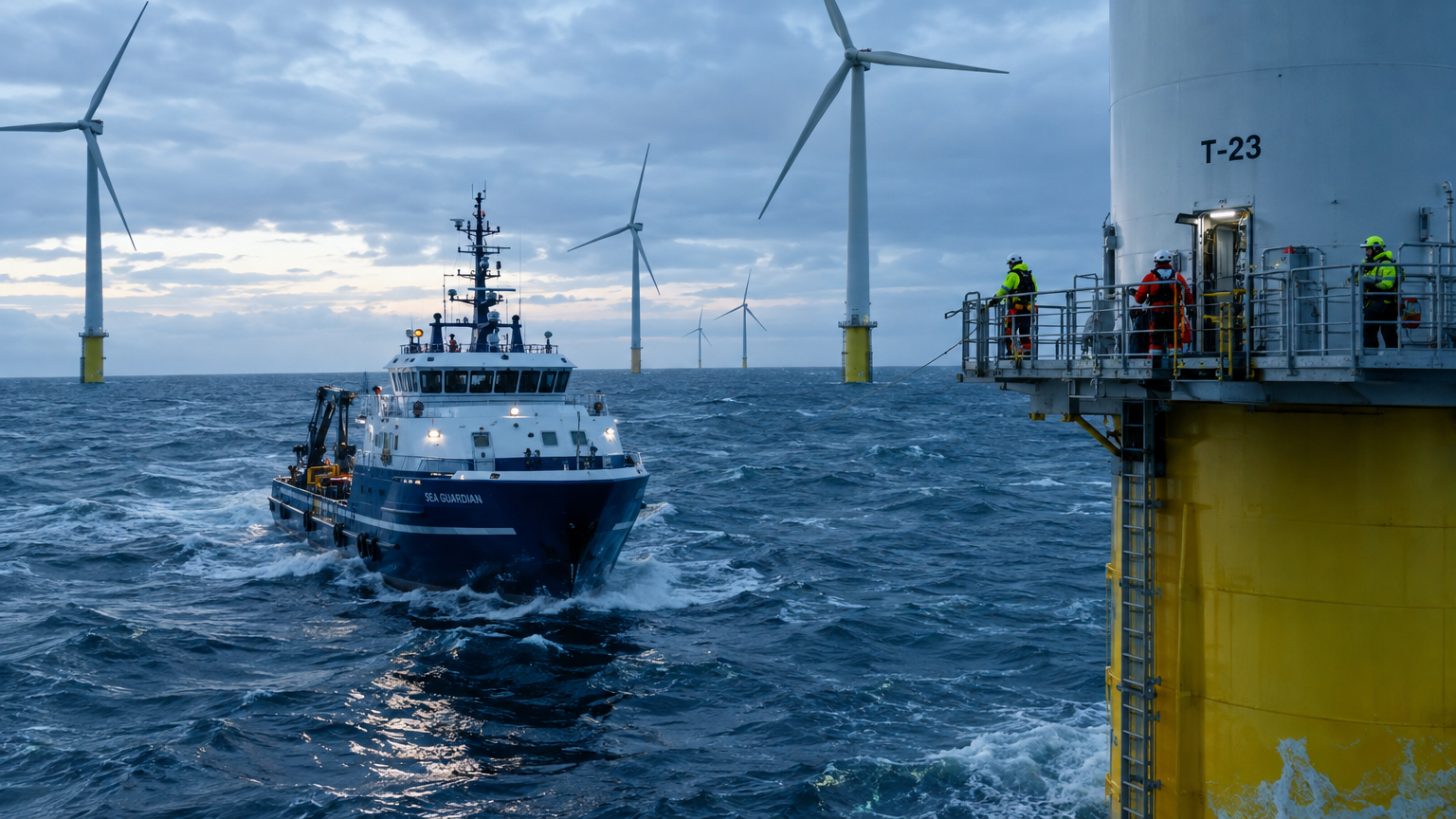 Offshore turbine access typically involves vessels, weather windows and transfer logistics — conditions that do not apply the same way onshore.
A peer-reviewed review of offshore wind farm O&M optimization based on digital twins discusses the offshore-specific challenges: environmental conditions, distance from shore, reliability, operator safety, and O&M costs. These findings are specific to offshore wind and should not be generalized to all onshore wind farms.
Onshore
Easier physical access in many cases — but fleets are geographically distributed, with turbines spread across ridgelines, farmland and steppe. The constraint is often travel time and scheduling across many dispersed sites, not the sea.
Offshore
Access can involve additional logistical, weather, safety and distance considerations — crew transfer vessels or helicopters, sea-state limits, and maintenance windows planned around forecasts rather than traffic.
From Preventive Maintenance to Condition-Based Strategies
These approaches are not interchangeable — most real O&M programs run a considered mix of all four, weighted by asset criticality and the data available.
Corrective maintenance
Action taken after a failure or defect is identified — restoring the asset once something has already gone wrong.
Preventive maintenance
Planned maintenance performed according to defined schedules or operating conditions, before a failure occurs.
Condition-based maintenance
Maintenance decisions informed by the observed or measured condition of the asset — inspection findings, sensor data, or both.
Predictive maintenance
Analytical approaches used to estimate future failures or deterioration before they occur, from modelling and accumulated data.
On the monitoring side, the SCADA-based condition-monitoring review covers how operational data supports model-based and data-driven approaches to fault detection. On the strategy side, the IEA's Innovation Gaps analysis for renewable power states that digitalization through advanced sensing and controls enables predictive maintenance, and reports that it is already reducing O&M costs. That is an IEA finding about the technology — not a guaranteed outcome for every wind farm that adopts a given tool.
The Role of Digitalization in Wind O&M
Digital data systems are increasingly relevant to O&M because the information a farm generates has outgrown binders, inboxes and isolated spreadsheets.
The IEA's Digitalisation and Energy analysis identifies digital data and analytics as mechanisms that can reduce O&M costs, improve efficiency, reduce unplanned downtime, and extend asset operating life. Note the direction of that claim: digital tools can produce these outcomes — no digital software automatically produces them.
Whether they materialize depends on how the information is actually governed in the organization:
A field-operations distinction
A dashboard that no one consults before a climb, a form that does not match what the technician actually sees on the component, or a report that cannot answer "what did we find on this turbine last time?" all represent digitalization without the loop. The technology is the easy half; the workflow and the data discipline are where the operational value is won or lost.
The Digital O&M Data Loop
Modern digital O&M is increasingly about creating a connected information loop rather than treating every inspection as an isolated record.
In this loop, each maintenance action writes back into the asset's history, and that updated history shapes the next inspection. A finding that ends in a closed work order but never reaches the asset record breaks the loop — the next crew to climb that turbine starts from zero.
What Is a Wind Turbine Digital Twin?
Not every turbine dashboard is a digital twin — and the term is used loosely enough that it is worth being precise about what it means.
A 2026 peer-reviewed review, Empowering Digital Twins for Wind Energy Operation and Maintenance, describes digital twins as virtual representations of physical wind turbines, and proposes a closed digital process spanning data acquisition, data management, virtual model construction, adaptive operations, diagnostics and prognostics, maintenance decision-making, resource planning, and maintenance execution.
Related reviews of digital twin technology in wind turbine components and of digital twin–enabled predictive maintenance across renewable technologies show the same pattern: a digital twin involves a deeper, two-way relationship between a physical asset, its data, models, analysis and operational processes. A visualization of a turbine is not automatically a full engineering digital twin — and maturity varies widely between implementations.
What Good Wind O&M Data Looks Like
A useful O&M record answers a short set of questions. This is a practical educational framework, not a formal industry standard — but a record that cannot answer them is usually not answering much later either.
What?
What was inspected — the turbine, subsystem, or component.
Where?
Which wind farm, turbine, subsystem, component or location.
When?
When the inspection or maintenance activity occurred.
Who?
Who performed the work, and who reviewed it.
What was observed?
The condition, defect, measurement or finding that was recorded.
Evidence?
Photographs, measurements, documents or other supporting records captured with the finding.
What happened next?
Whether maintenance was required, an issue was closed, or follow-up remained open.
Historical context?
Whether the current observation can be compared with previous observations of the same component.
The Problem With Disconnected O&M Information
No serious claim can be made that the whole wind industry works on paper or spreadsheets — many farms run well-integrated systems. But in some O&M workflows, information ends up scattered.
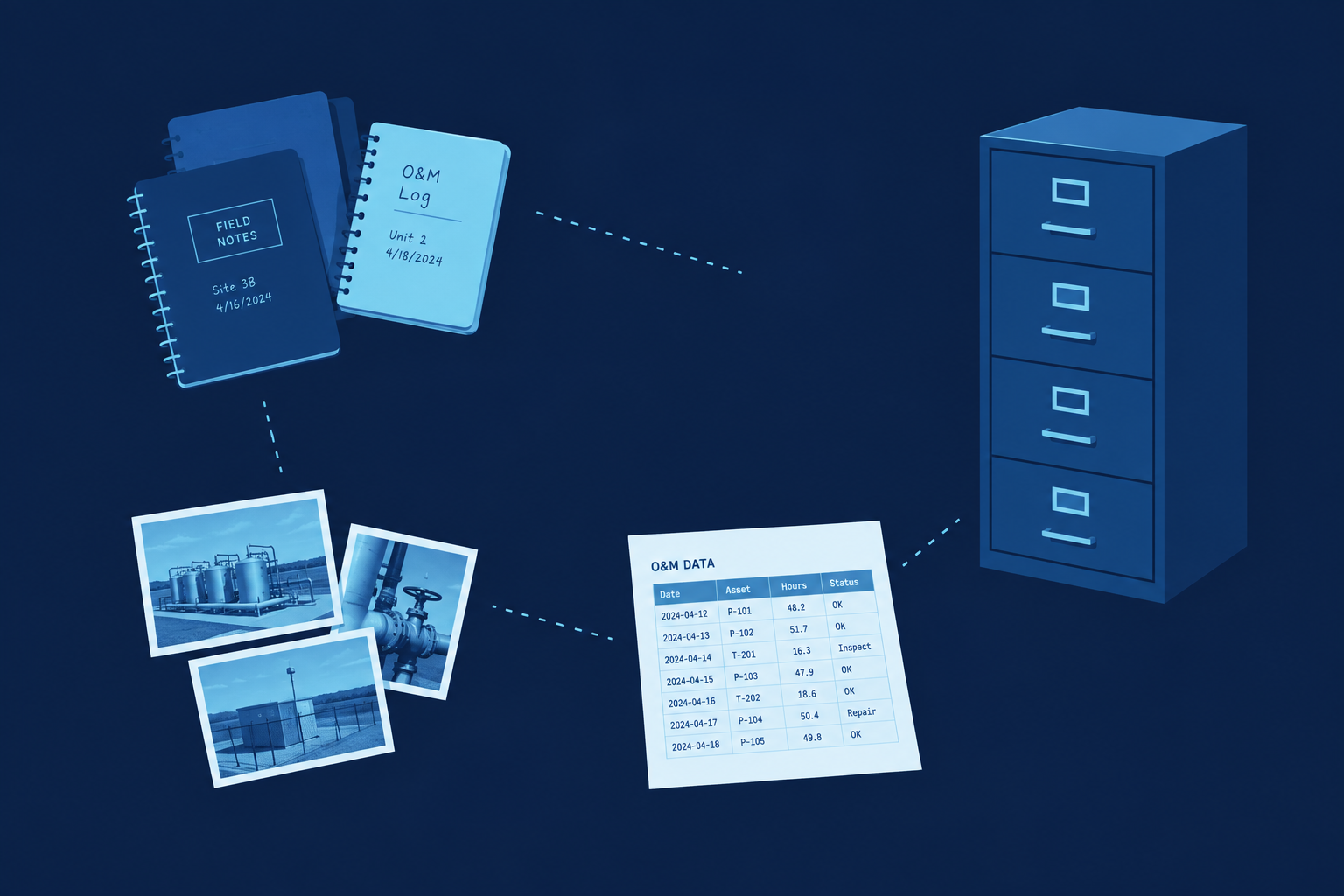 Fragmented information: notes, photos, spreadsheets and reports that describe the same turbine but live in different places.
Field notes in one location
Photographs stored separately from the findings they show
Spreadsheets used for tracking work
Maintenance records in another system
Reports generated separately for each audience
Asset information maintained apart from inspection history
Historical records difficult to search
Field and office teams working from different versions of the same information
Where information is distributed across multiple tools, the operational challenge can become less about maintaining the turbines and more about reconstructing what is known about them — assembling the inspection history of a single component from four places before an engineering decision can be made.
What a Connected Field-Data Workflow Can Look Like
A connected workflow closes the gaps above: information is captured once, in the field, and flows — with the asset — through review, reporting and analysis.
Prepare
Select the turbine, asset or inspection activity.
Capture
Record structured observations, measurements, photos and notes on site.
Validate
Check that required information is present and correctly associated with the asset or component.
Synchronize
Transfer field information into the central system when connectivity is available.
Organize
Associate the information with the relevant asset and its historical record.
Review
Let office and technical teams review field findings.
Report
Generate or assemble the required documentation.
Analyze
Use accumulated information to understand recurring findings, asset history and operational patterns.
Act
Use the information within the organization's maintenance and engineering processes.
What the loop needs
Two steps in this workflow — validate and synchronize — are where disconnected processes usually fail. A record that reaches the office missing its component association, or that never leaves the technician's device, cannot feed the asset history that later work depends on.
This is a general conceptual workflow, not a description of any specific product. The same pattern appears in the evidence expectations of IEC TS 61400-28: decisions about through-life management depend on evidence that is organized, retrievable and tied to the asset.
How aQRate Supports This Workflow in Wind Farm O&M
Most of this article has been about the domain. This part is about aQRate — kept short, and kept separate from the facts above.
In the field
Wind technicians and field crews can carry structured inspection forms — like the rotor and blade inspection example below — on a phone or tablet, capturing findings, measurements and photos against a specific component on a specific turbine, instead of typing them up afterwards.
Back in the office
The same records are organized by asset, searchable across the fleet, and available to the people reviewing findings, planning maintenance or preparing reports — so the inspection history of a component stays attached to that component.
aQRate's objective is to reduce the administrative burden associated with managing field data, with aQRate stating that its workflow can reduce administrative work for managing data by up to 50%. That is an aQRate claim, not an independent research finding.
What aQRate is not
aQRate is a field-data collection and inspection-management platform — the layer that captures, organizes and reports inspection and maintenance information. It works alongside the systems above; it does not:
Replace SCADA, condition-monitoring or OEM turbine-control and monitoring systems — those systems keep their roles.
Perform condition monitoring or predictive maintenance, predict turbine failures, or calculate remaining useful life.
Try a Wind Farm O&M Inspection Form
The interactive demo below is a working starter template for repeated rotor and blade inspections — try it on a phone-sized viewport too.
Rotor & Blade Inspection-Repeated Form
Blade Identifier*
Leading-Edge Erosion*
Surface Cracking/Delamination*
Lightning Receptor Resistance (Ω)*
Tip Mechanism Function *
Blade Log Photo
Rotor & Blade Inspection-Repeated Form
Blade C
None
None
0.02
Pass
Photo captured
Report ready: Wind Turbine 3-Page O&M Audit
Ready to Explore Wind Farm O&M Software?
If the workflows above resemble your operation, you can see how aQRate's wind farm O&M starter template works in practice.
Frequently Asked Questions About Wind Farm O&M
Short answers with sources — the same sources cited throughout this article.
According to the GWEC Global Wind Report, global installed capacity reached 1,299 GW at the end of 2025, with 165 GW added that year — and wind power is now generated in 138 countries (GWEC).
For the 2025 installation year, GWEC reports 28,395 new turbines installed across 57 countries (GWEC). The exact number varies from year to year.
An NREL analysis of wind energy costs indicates that O&M accounts for 17%–34% of the levelized cost of wind energy (NREL). The range reflects the levelized-cost framework used, which covers the full life of an installation — it is not simply the share of turbine cost.
The 2024 NREL Annual Technology Baseline uses an OPEX reference value of $44/kW-year for a 2022 market-average 3.2 MW land-based wind turbine (NREL ATB). It is a reference value for a specific turbine class, not a universal number.
The DOE Career Map notes that wind technicians may perform maintenance, inspections, troubleshooting and other duties such as testing electrical components and maintaining records (DOE).
There is no single rule — inspection scheduling is defined by the O&M strategy and service agreements. IEC TS 61400-30:2023 addresses safety in wind turbine operation and maintenance, and IEC TS 61400-28:2025 addresses through-life management and evidence-based decision-making (IEC 61400-30, IEC 61400-28).
SCADA systems continuously monitor the operating state of the turbine — supervisory control and data acquisition — while inspections are systematic examinations of the physical asset. A peer-reviewed review covers SCADA-based condition-monitoring approaches to fault detection (Elsevier).
Corrective (after failure), preventive (planned), condition-based (based on observed condition) and predictive (anticipating failures from data and models). The IEA reports that digitalization through advanced sensing and controls enables predictive maintenance and is already reducing O&M costs (IEA).
A peer-reviewed 2026 review describes a digital twin as a virtual representation of a physical wind turbine, supported by a closed process spanning data acquisition, virtual models, diagnostics, prognostics and maintenance decision-making (Elsevier). A dashboard alone is not automatically a full digital twin.
The IEA finds that digital data and analytics can reduce O&M costs, improve efficiency, reduce unplanned downtime and extend operating life (IEA). Whether those outcomes materialize depends on data quality, integration, adoption and processes — not on the software category alone.
A review of offshore wind farm O&M optimization identifies environmental conditions, distance from shore, reliability, operator safety and costs as offshore-specific challenges (Elsevier). Offshore access involves vessels, weather windows and stricter logistics.
aQRate focuses on managing field data and records — structured inspection forms, asset organization, and reporting. aQRate states that its workflow can reduce administrative work for managing data by up to 50%. It is not a SCADA or condition-monitoring system and does not perform predictive maintenance — see wind-turbine-om.aqrate.ca.
Sources & Further Reading
Every statistic and claim in this article is cited inline to one of the sources below. These are the exact references used.